Why Buy-Side Professionals Deserve a CRM Built for Them
By: Mel Sutton, ALTALLO - Founder
Published: 2026-03-30 · Read time: 8 min · Category: Technology
Beatrice Larson, Founder of Mariner CRM, on why the buy-side needs purpose-built relationship management tools, and why generic platforms have held the industry back.
[HOST]: Some may see the CRM space as mature and crowded. What has fundamentally changed that made now the right moment to build something new?
[GUEST]: It's mature only for industry-generic CRM platforms - that's not true for regulated buy-side financial services. We've had the same generic systems for decades now. They don't support our workflows, can't model complex relationships, don't capture the right client data, and miss how trust, credibility, and relationships drive outcomes in our industry.
The CRMs haven't changed, but everything else has. You've got increasingly regulatory complexity - transparent audit trails, AML/KYC, MiFID II requirements. Growing data fragmentation across legacy enterprise systems, notebooks, Post-It notes, spreadsheets, and emails. Rising demand for AI-driven productivity and insights, not just data storage. And increasing operating costs coupled with significant fee pressure affecting investment firms of all sizes.
We built Mariner CRM to address these changes and fill a gap. It's a purpose-built, compliance-native CRM that's only for buy-side professionals. And it's ready to be used as soon as you buy it without expensive and complex customisations or retrofitting.
[HOST]: You've said this is the product you wished you had. What were the specific moments where existing systems broke down for you in practice?
[GUEST]: When I felt like I had to learn to code to even enter the details of a client call in the CRM system!
I'm exaggerating, but seriously, it was such a hassle to capture, organise, and retrieve data in these systems. Getting data into the systems, organising it all, and then actually retrieving it later was more effort than it should have been. The systems weren't intuitive, they couldn't handle multi-entity client structures or stakeholder networks, and compliance tracking was hit and miss.
[QUOTE]: In our industry the average sales cycle for an institutional client takes 36 months. And there will be multiple interactions without an active opportunity or investment mandate for much of the time period.
[GUEST]: Even worse, everything was transactions-oriented. That works if your clients are buying widgets from you daily, but in our industry the average sales cycle for an institutional client takes 36 months. And there will be multiple interactions without an active opportunity or investment mandate for much of the time period.
I just ended up writing everything down in my paper notebook, saved stuff in my Outlook folders, and used spreadsheets and Word documents to track everything. I didn't see the value in putting myself through the rigmarole of learning these CRMs, so I created my own easy shadow system.
[HOST]: Most CRMs are designed to be flexible for everyone. What does designing specifically for investment professionals allow you to do differently at a product level?
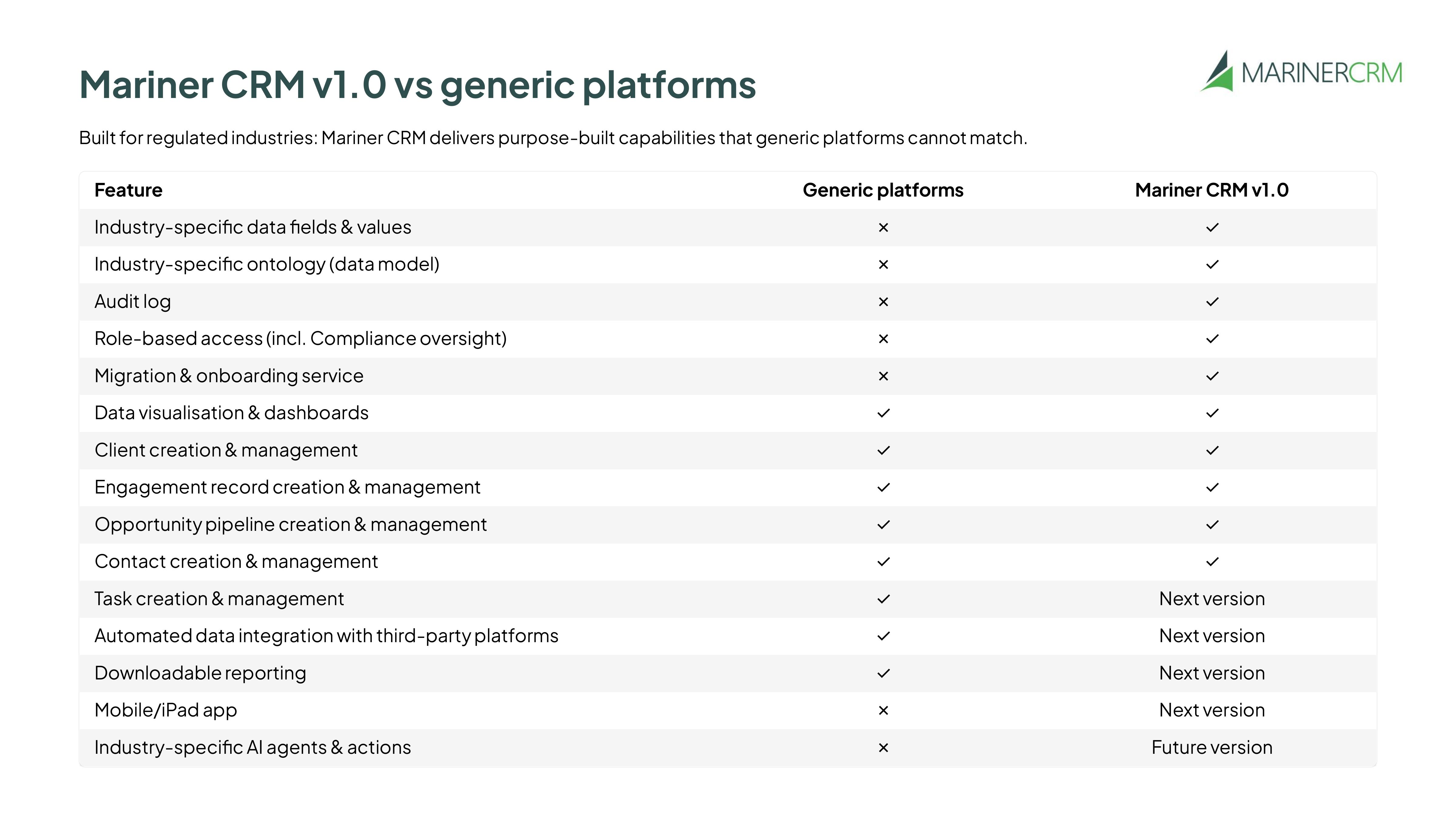
[GUEST]: Most CRMs are designed to be flexible for everyone, but that's their weakness too, because it makes them generic and shallow. Mariner is a specialist tool for client-facing, buy-side professionals, which means it's precise, relevant, and immediately usable. Our team's lived experiences informed Mariner's design and core functions. We created native modelling of the complex hierarchies of legal entities and relationships, which dominate the industry and which we want to accurately capture and dynamically update. We embedded audit and compliance requirements directly into workflows. And we identified and included industry-specific data fields as part of our alignment with long-term, relationship-driven sales cycles.
The result is that users don't need to customise Mariner CRM just to make it usable. They can use Mariner immediately, which removes a big barrier to adoption as well as reducing cost.
!Mariner CRM v1.0 vs Generic Platforms — Differentiator Matrix
[HOST]: Many firms adapt their processes to fit their systems. What's the hidden cost of that, and how did you approach flipping that dynamic?
[GUEST]: Through multiple customer discovery interviews, we validated our insights around the costs that users and their employers end up paying. You lose productivity, as senior and expensive executives end up doing admin.
Customisation's expensive and, for some smaller investment firms, prohibitively so. Even when management invests in customisation, there's minimal use, and ROI is low. We also know users are running their own shadow systems in parallel with the official CRM platform.
This leads to revenue leakage, because low adoption results in incomplete and inaccurate records. There are missed opportunities, increased key man risk, and compromised auditability and transparency.
[QUOTE]: We flip this dynamic by designing Mariner around how users really work, rather than forcing them to adapt to the system.
[GUEST]: We flip this dynamic by designing Mariner around how users really work, rather than forcing them to adapt to the system. It's meant for the busy user who needs easy-to-use tools and wants a frictionless user experience. Their activities are regulated, so data must be accurate, organised, updated, and accessible. It drives better decision-making, deeper client relationships, and quantifiable business growth.
[HOST]: A lot of platforms capture data well but don't drive outcomes. How have you built Mariner to actively support revenue generation and client growth?
[GUEST]: We'd like to challenge that premise: we don't believe that these platforms capture data well, and that's when the problem starts with negative downstream impacts.
Mariner's all about making data capture so effortless it's not a cognitive burden - it should happen naturally as part of a user's daily workflow. It prioritises engagement rather than transactional behaviour. Its proprietary data model reflects the industry's realities. It has dashboards with metrics that matter to us in the industry - things like AUM, investable assets, asset allocation. Its opportunity tracking and pipeline analytics align with our standard sales cycle. Most importantly, it isn't just recording activity, it's helping users prioritise their interactions, identify opportunities, and manage relationships. So Mariner turns data into actual revenue outcomes.
[HOST]: You focus heavily on structured relationship tracking. How does that change the way teams understand and manage client relationships day to day?
[GUEST]: Structured relationship tracking changes how teams work from day to day. Rather than relying on fragmented notes and personal memory, teams have a shared, comprehensive view of client relationships. Mariner is that one centralised place where every interaction, stakeholder, and relationship development is captured. It gives you a longitudinal view rather than random snapshots.
That way you can prepare for meetings more effectively, have seamless conversations across multiple business functions and colleagues, and critically, you can identify both risks and opportunities earlier. You're building on continuously updated relationship history instead of a series of constant starts and stops.
And from an organisational perspective, key man risk is eliminated or minimised, because there's continuity and full visibility for the whole team. They can collectively make better decisions, manage stronger client relationships, and deliver better business outcomes, including improved revenue.
[HOST]: Firms already have huge amounts of data. How do you ensure Mariner delivers clarity and actionable insight rather than just more information?
[GUEST]: It's true that there's a huge amount of data out there, but that's not the problem - the problem is that much of it is poorly structured.
With Mariner we focus on turning data into signals by not just capturing client information, but also client context information - the why, how, where, when, and who of relationships. From there, we highlight critical information through dashboards, which enables users to prioritise their client activities. Our focus is on not overwhelming them with raw data but on dialling down the white noise, so they get clearer views of their client relationships, such as seeing potential opportunities and risks.
We're building on this with future AI-enabled capabilities, such as relationship summaries, prioritised product recommendations, and behavioural insights. The intention is to support enhanced decision-making and prime users for action.
[HOST]: You've embedded auditability and full history into the core. How does building compliance in from day one influence both trust and usability?
[GUEST]: Our users operate in regulated environments, so compliance isn't a nice-to-have, it's mandatory.
By embedding auditability in the workflows, we demonstrate that we understand their risk management and regulatory needs and that we take them seriously too. Instead of being something manual, compliance is at the heart of Mariner and becomes automatic.
This means that users are less likely to develop parallel record-keeping systems and can avoid duplicative work. Users can trust Mariner, knowing that it's easier to use and there's better resulting data consistency.
[HOST]: The biggest challenge with any CRM is consistent use. What have you done to ensure this becomes a tool people rely on, not avoid?
[GUEST]: Everyone knows that using CRMs feels like a chore. No one chooses to use them - they're typically mandated.
So we started with one principle for CRMs: easy to buy, easy to learn, easy to use. In other words, if it's difficult to sign up for and requires extensive onboarding and refresher training to learn and use, adoption is going to be poor or non-existent.
[QUOTE]: Easy to buy, easy to learn, easy to use. If it's difficult to sign up for and requires extensive onboarding, adoption is going to be poor or non-existent.
[GUEST]: With Mariner, we focused on creating a frictionless user experience. We designed a deliberately minimalist user interface with only the most essential elements, and streamlined workflows that reflect what you'd really do day to day. We also built industry-specific data fields and values, so no need for customisation to get going.
Most importantly, users see value from day one: they log in and see their pipeline, their client activity, and what needs their immediate attention, which helps them to prioritise their day. The user sees Mariner as something to rely on to run their workflow instead of being something they have to update after the fact. Adoption then becomes natural and isn't forced.
[HOST]: As the platform evolves, do you see Mariner remaining a CRM, or becoming a broader system of intelligence for investment professionals?
[GUEST]: We want Mariner to evolve into an intelligence system, not just a CRM. With future releases we're planning long agents for productivity and relationship management, AI automation of standardised workflow, predictive analytics for both current and prospective clients, and integration with legacy enterprise systems including Salesforce, Microsoft, and Bloomberg. Mariner then becomes a solid data foundation for broader decision-making across multiple phases of the client lifecycle.
[HOST]: Finally, what's something widely accepted about client relationship management in your industry that you believe is fundamentally wrong?
[GUEST]: That we should just put up with bad technology and that client-facing activities are just impossible to capture well. It's clear to us that this mindset limits how investment firms service their clients.
The usual justifications given are lack of a budget, bias towards brand names, lack of alternative systems, and lack of compelling UI/UX. But signs are pointing to changing client demands: they want more personalised services and products, more problem-solving rather than product-pushing, and they're willing to pay for higher-quality relationships over transactional interactions.
[QUOTE]: It's difficult to meet and capitalise on these changes if your technology doesn't centre your industry or clients at its heart.
[GUEST]: It's difficult to meet and capitalise on these changes if your technology doesn't centre your industry or clients at its heart. You're not growing your business if that misalignment exists. And even though it's preventable, it does require a shift in mindset.